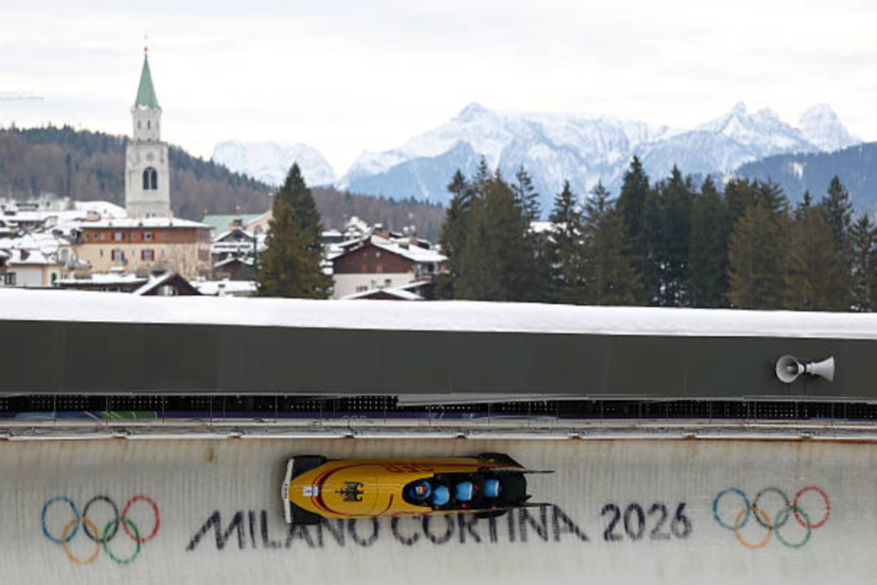
With the 2026 Milano Cortina Olympics officially in the books, Around The Corn wanted to take the opportunity to rewind and celebrate some of the top athletes and their contributions that will ensure that the memories of the XXV Winter Olympiad will live on for years to come.
This article is intended to highlight the “heroes” of the most recent Games.
Embed from Getty Images
Rich Ruohonen
Ruohonen not only proved that age is just a number, but that you have to be ready to perform at a moment’s notice. The 54-year-old personal injury attorney from Minnesota made history in Italy as the oldest athlete to participate at a Winter Games, but that almost never happened. Initially slated to be an alternate for the United States men’s curling squad, Ruohonen was thrust into action during the team’s match on February 12, solidifying his place in the record books.
Initially making his debut in a curling championship event in 1998, it has been a long road for Ruohonen. Whether it be an opportunity to become an Olympic athlete or to start something as simple as a workout routine you’ve been putting off, Ruohonen’s journey is proof that very little is truly out of reach.
Embed from Getty Images
Lucas Pinheiro Braathen
Feeling the weight of an entire country is something that many athletes can relate to, but how about the weight of an entire continent? Such was the case for Pinheiro Braathen, a Norwegian-Brazilian skier who represented his mother’s homeland of Brazil in the 2026 Games. Initially representing Norway before a brief retirement, Pinheiro Braathen decided to switch to donning the Brazilian colors in 2024.
This meant that he was amongst a relatively small collective of South American athletes at the Winter Olympics. However, he entered a league of his own entirely when he captured gold in the men’s giant slalom event, the first medal of any kind for his country and for the continent as a whole. Olympic champion? Yes. Trailblazer? Also yes.
Embed from Getty Images
Vladyslav Heraskevych
The Ukrainian skeleton racer is already one of the more revered athletes in his discipline, becoming the first for his country to participate at an Olympic Games. Unfortunately, Heraskevych’s story was far more polarizing in 2026. As a way to honor various Ukrainian athletes and coaches who had lost their life in the country’s ongoing war with Russia, Heraskevych had been wearing a special helmet with the likenesses of those individuals during training runs.
Despite multiple attempts by the IOC to persuade Heraskevych to wear a different helmet for the actual competition runs, the 27-year-old refused, stating a “medal is worthless in comparison to people’s lives and, I believe, in comparison to the memory of these athletes.” This stance left the IOC with the difficult decision to disqualify Heraskevych from competition, which resulted in raw emotions from many of those involved. In the end, while Heraskevych was unable to race, his decision to maintain his beliefs had a reverberating effect and served as a reminder about what it truly means to represent one’s country.
Embed from Getty Images
Alysa Liu
Thanks to family ties (her father is a Chinese dissident who was a participant in the Tiananmen Square Protests), Liu became a lighting rod of sorts for political discourse that ensued throughout these Olympic Games. However, true to her character, Liu never seemed to be bothered by the outside noise, bringing home gold in both the team event as well as the women’s singles event. Her infectious smile was enough to make her a darling of the Games, but the medals certainly didn’t hurt, either.
While the commentary about her background and upbringing felt like it took center stage at times, it shouldn’t be lost on anyone that Liu is the first gold medalist in the women’s singles event since Sarah Hughes in 2002. It’s an important event to Americans, even if it had been two decades since they’ve produced an Olympic champion. She’s a bonafide star now, with an uncharacteristic combination of mental fortitude and casual demeanor that makes her impossible not to admire.
Embed from Getty Images
Ski Dog
You may not have watched the cross-country skiing women’s team sprint free, but there’s little chance you could have missed the real star of the show. Almost instantly becoming a viral sensation was the pup who got loose from its owner during a nearby walk, ending up on the course during one of the event’s heat races.
Not much is known about the rambunctious dog, but its mad dash across the finish line was both equally and impressive and humorous – provided you weren’t one of the course officials trying to reign it in.
Embed from Getty Images
Ebba Andersson & the Swedish cross-country skiing relay team
It’s not often that a silver medal truly feels great to a competition favorite, but it’s safe to say that given the hardships Ebba Andersson faced during the women’s 4×7.5 kilometer relay race, silver was as good as gold for the Swedes. Skiing the second leg of the event for her team, Andersson fell not once – not twice – but three times, ultimately losing one of her skis during the third tumble. Skiing on one leg for part of her stint, the prospects of competing for a medal looked bleak.
Andersson’s teammates were up for the challenge, however, mounting a furious comeback in the race that ended up seeing Sweden take second place after being as low as eighth following the falls. As someone who has personally experienced the triumph of a team result after completing a race in which crucial gear was lost in the middle of the event, this was one of my favorite performances of any Games, let alone in 2026.
Embed from Getty Images
Johannes Høsflot Klæbo
The 29-year-old Norwegian skier, a three-time Olympian, officially became King of the Snow Hill in Italy, amassing a record six gold medals in the most recent Games. This wasn’t an entirely shocking display of dominance, either. In addition to winning the most gold medals in a single Games, Høsflot Klæbo also holds the record for most Winter Olympic medals by a single athlete, with 13 in total (11 of them golden).
Høsflot Klæbo trails only Michael Phelps for number of medals by any Olympic athlete, Winter or Summer, but has certainly positioned himself as the icy version of Phelps.
Embed from Getty Images
Embed from Getty Images
United States men’s and women’s hockey teams
A lot of parallels exist between the gold medals that the United States men’s and women’s hockey teams earned in these Olympics. For one, it was the third gold all-time for both sides. Both teams also had to best incredibly talented Canadian squads to hear their national anthem being played during the medal ceremony. And in both cases, it took a dramatic overtime effort to dispatch of the Canadians by a score of 2-1.
But perhaps more importantly, it’s the perception about what these gold medals will mean moving forward that make them both so special. For the women, it’s a beacon for young girls that watched to aspire to be something great, while a fledgling professional league in the States continues to train its skating legs. For the men, it’s a victory that invokes memories of 1980, at a time where the country felt like it needed a win almost as badly as it did then. These Games were contentious at times, but the hockey golds for the United States made it easy to forget that here at home.